
The Crémone Bolt: The Signature of the French Window
Two rods, one turn of the handle, and nearly two centuries of Parisian elegance.
Open a window in a Paris apartment, a Loire Valley chateau or a manor in Provence and your hand will find the same thing: a crémone. It is a tall vertical bolt on the face of the window. When you turn the knob or lever, one rod slides up into the head and the other slides down into the sill.
The crémone does more than lock the window. It draws a fine vertical line down the center of the pair, and it is the detail that makes a French window look French. At Chablais we fit crémone bolts on our French casement windows and French doors, from simple forged iron to hand-chased bronze.

What is a crémone bolt?
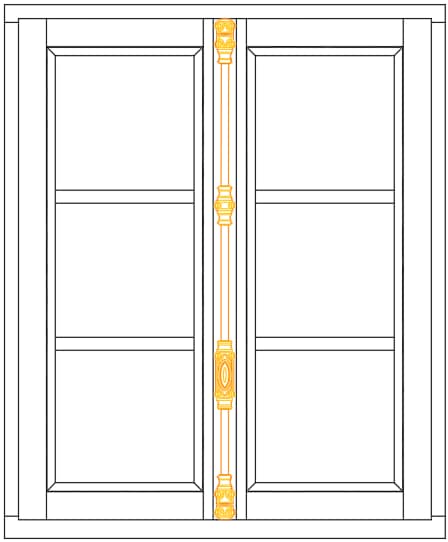
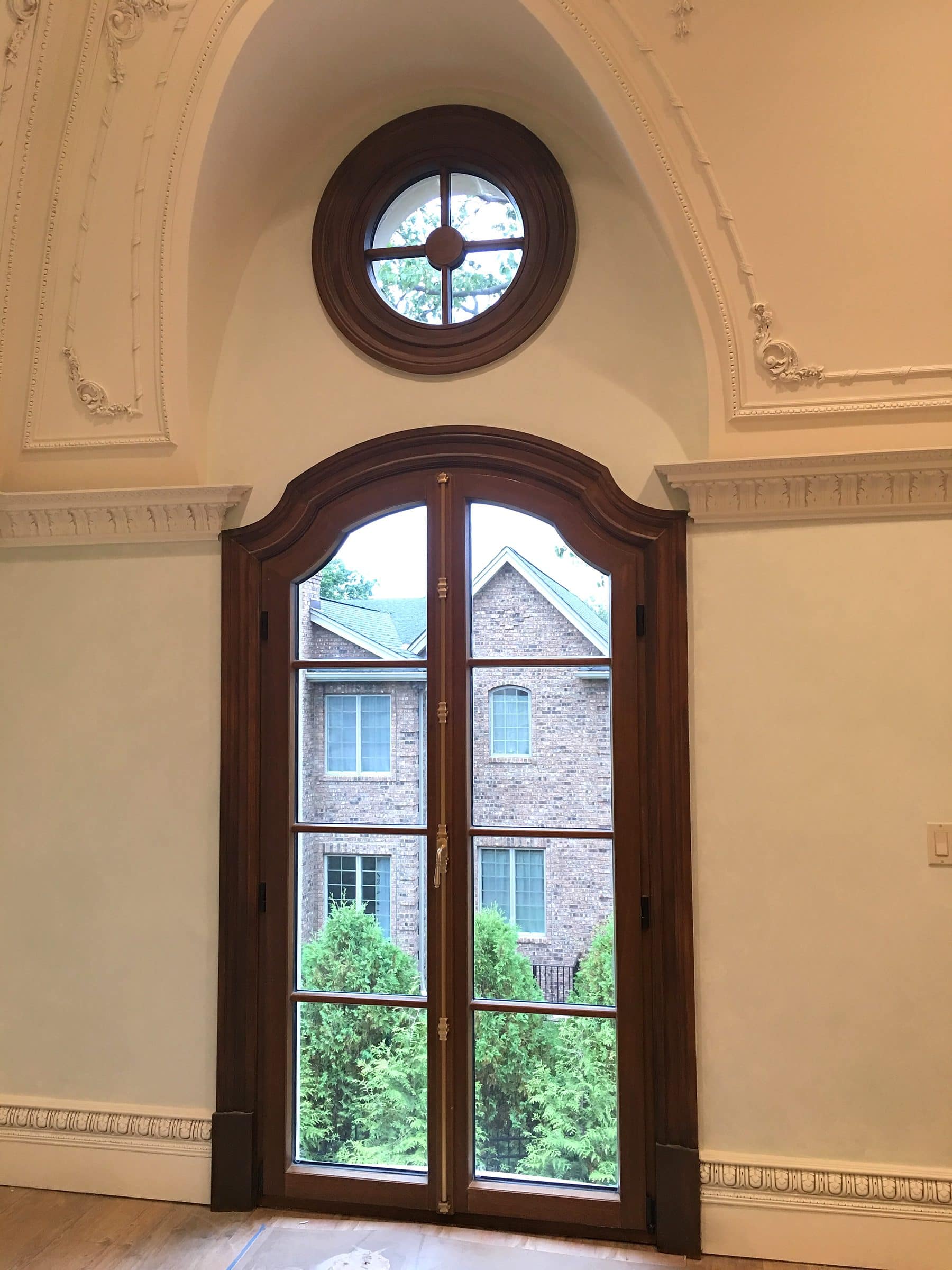
A crémone bolt (French: crémone) is a surface-mounted lock for tall casement windows and French doors. A knob or lever turns a small gear inside the body. The gear pushes two rods in opposite directions, one up into a keeper at the head of the frame and one down into a keeper at the sill. The sash is held at the top and the bottom, so a tall window closes tight along its full height.
A short history
Before the crémone, French windows used the espagnolette, a single long rod that rotates to hook the frame. It appeared in the 17th and 18th centuries. It was beautiful but costly: each one had to be forged to the exact height of its window.
In the 19th century, Paris locksmiths developed the crémone. Its rods can be cut to any length, so one model fits every window, and it closes the sash tighter against drafts. The house of Rémy Garnier, founded in 1832 in Burgundy, counts its founder among the inventors of the crémone.
The timing was perfect. Under Baron Haussmann, from the 1850s, Paris was rebuilt with thousands of limestone apartment buildings with tall French windows, most of them closed by a crémone, usually in plain gray cast iron with a brass knob. Chateaux and grand town houses used the same system in chased bronze, in Louis XV, Louis XVI and Empire styles. That is still the look people picture when they think of French windows today.
Crémone vs espagnolette: what is the difference?
In the US the two names are often mixed up, even by hardware sellers. They are two different mechanisms.
| Crémone | Espagnolette | |
|---|---|---|
| Rods | Two rods, one up and one down | One single rod, full height |
| Movement | Rods slide vertically (gear and rack) | Rod rotates on itself |
| Locking points | 2, at the head and at the sill | 3: hooks at top and bottom + handle in a center keeper |
| Handle | Small knob or lever on a compact body | Long lever that folds down flat on the sash |
| Era | 19th century to today (Haussmann Paris) | 17th to 19th century (Versailles, older chateaux) |
| Fitting | Rods cut to length on site | Made to the exact height of the window |
| Best for | Most French windows and doors | Period restorations, very old-world look |
Both are beautiful. For a new home in the French style, the crémone is the usual choice. The espagnolette is the pick for a very early chateau look, or to match an existing historic window.
How a crémone works
The parts
- Body (boîtier): the decorative case holding the gear, mounted at hand height.
- Knob or lever: turns the gear, usually a quarter turn.
- Rods (tringles): traditionally half-round, about 5/8 in. wide (16 x 8 mm), cut to the height of the window.
- Guides: small brackets along the sash that hold the rods straight and let them slide.
- Keepers (gâches): fixed at the head and the sill, they receive the rod ends.
- Finials: decorative caps at the rod ends, often matching the knob.
Three ways to fit a crémone
- Surface-mounted, fully working (en applique). The historic, Old World way. The rods you see are the rods that lock the window.
- Concealed (encastrée). The mechanism is hidden inside the sash and only the knob shows. Clean, but you lose the classic vertical rod.
- Decorative crémone on a multipoint lock. The body, rods and finials are on the surface for the look, and the knob drives a concealed multipoint lock through a 7 mm square spindle. The window gets the classic French look plus several modern locking points and a tight weather seal.
Chablais offers both: a fully working crémone on our flush Old World windows, and a decorative crémone on our overlap windows (see below).
Where the crémone sits: inswing or outswing
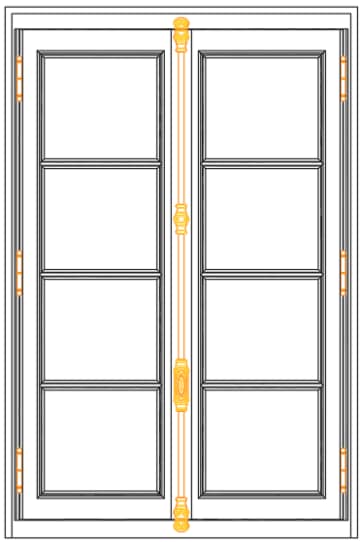
On a true French window the two sashes open inward, and the crémone sits right in the middle, on the astragal where the two sashes meet. That centered vertical line is the classic French look. In France almost every window opens inward.
On an outswing window the crémone cannot be centered. It moves to the face of the active sash, off to one side, and the pair looks very different.
Many American homeowners worry that an inswing window will hit curtains or furniture. In practice these windows are opened less often than people think, and it rarely gets in the way. Our advice is to decide room by room. If outswing is the right answer somewhere, we make it outswing, no problem. Just keep in mind that when inswing and outswing units sit in the same room, the two designs will not match.
Styles and finishes
The crémone should match the architecture of the house, and the rest of the hardware in the room.
| Style | Look | Fits |
|---|---|---|
| Louis XV | Curves, shells, asymmetric rococo scrolls | Grand salons, chateau interiors |
| Louis XVI | Straight lines, ribbons, beads, oval knobs | Classic French manor, formal rooms |
| Empire | Heavy, symmetrical, laurel and palmettes | Neoclassical homes, libraries |
| Haussmann | Plain body, olive or round knob | Paris-apartment look, modern French |
| Rustic / forged iron | Hand-hammered black iron | Country French, Provence, farmhouse |
| Contemporary | Slim body, clean rods | Modern homes with a French accent |
Materials: solid bronze (the top of the range, cast and hand-chased), solid brass, cast iron, and hand-forged iron.
Finishes: polished or satin brass, antique or aged brass, natural or patinated bronze, satin nickel, black iron, pewter, rust finish. The rods and finials always come in the same finish as the body.

Crémone bolts on Chablais French windows and doors
We supply a quality crémone with our French casement windows and French doors, in the finish of your choice. It is the detail our clients ask for first on French château homes in Atlanta and Nashville, in Texas and in the Northeast. How the crémone works depends on which of our two window designs you choose.
| Flush window: classic Old World French design | Overlap window | |
|---|---|---|
| Sash and frame | The sash sits flush with the frame, one flat face | The sash overlaps the frame |
| Crémone | Fully working: the rods slide up and down and lock the sash at the head and the sill | Decorative: the rods stay fixed, and the knob drives a concealed multipoint lock through a 7 mm square spindle |
| Look | The authentic look of historic Paris windows and French chateaux | The classic French look with modern multipoint hardware |
For a true Old World French home, the flush window with a working crémone is the most authentic choice.
- Right or left, centered or on the sash: we set the position with you on the shop drawings.
- Matched finish: the crémone is chosen together with the hinges, finials and door hardware so the whole room is consistent.
- Heritage bronze on request: for a chateau or a landmark home, the window can be prepared for a crémone from one of the great French bronze houses, or for a piece you already own.
- Doors too: French doors, garden doors and tall windows up to full-height openings.
To complete an Old World window, see also our specialty glass and divided lites, and vacuum glass windows, which keep the sash as slim as a historic window with triple-pane insulation.
The great crémone houses
A few workshops keep this art alive. Here are the names we respect, in France, in Europe and in America.
France
| House | Since | Known for |
|---|---|---|
| Rémy Garnier | 1832 | Hand-chased bronze, founder counted among the inventors of the crémone; showroom in New York |
| Maison Fontaine | 1740 | Bronze cast from original molds, Louis XV and Louis XVI; Paris, rue de Rivoli |
| Bronzes de France | – | 20+ bronze models from Gothic to Haussmann and Art Deco; showroom in New York |
| Bouvet | 1884 | Hand-forged iron and brass, rustic and country French |
| Brionne | – | Wrought iron and solid brass, historic monument work |
| Fonderie Rollinger | – | The last cast-iron hardware foundry in France |
Europe
| House | Country | Known for |
|---|---|---|
| Vervloet | Belgium, 1905 | Lost-wax bronze, 19th century and Art Nouveau designs |
| Frank Allart | England | Door crémones with key or thumbturn options |
| Croft | England | Slim modern and classic crémones, 25+ finishes |
| Reguitti | Italy | Brass crémones with external rods |
America
| House | Where | Known for |
|---|---|---|
| P.E. Guerin | New York City, 1857 | Hand-cast in Manhattan, Louis XVI, Empire, French steel |
| Nanz | New York | Custom crémones for French doors |
| E.R. Butler & Co. | New York | Vervloet crémones and espagnolettes |
| H. Theophile | New York, 1882 | Crémones paired with their knobs and levers |
| Rocky Mountain Hardware | Idaho | Solid bronze sets, up to 9 ft |
Price guide: a crémone runs from about $250 for forged iron to $3,000 or more for a full bronze door set. Hand-chased French bronze is priced on request.
Frequently asked questions
What is a cremone bolt?
A cremone bolt is a surface-mounted lock for tall French windows and doors. Turning the knob or lever moves two rods, one up into the head and one down into the sill.
How do you pronounce crémone?
“Kray-MOHN.” The word is French, and the accent on the first e is often dropped in English.
What is the difference between a cremone and an espagnolette?
A cremone has two rods that slide up and down. An espagnolette has one long rod that rotates to hook the frame at the top and bottom.
Is a cremone bolt secure?
A cremone locks the sash at two points, at the head and the sill. On our overlap windows the cremone drives a concealed multipoint lock with several locking points.
Can a cremone bolt go on French doors?
Yes. On a pair of French doors the cremone is centered where the two doors meet, and a keyed version can be used on exterior doors.
Do cremone bolts work on outswing windows?
Yes, but the cremone can’t be centered. It sits on the face of the active sash instead of the middle of the pair.
Is a cremone bolt OK on a bedroom egress window?
A knob or lever cremone opens from inside without a key, which is what egress rules ask for. Avoid a keyed cremone on a required escape window, and check with your local building department.
Designing a French chateau or an Old World home?
Tell us about your project. We will help you choose the window design, the crémone and the finish, and prepare detailed shop drawings for your approval.